Views: 0 Author: Site Editor Publish Time: 2026-09-09 Origin: Site

Stretch fabrics do not all need the tight pull or high extension of spandex. For dresses, trousers, blouses, and lightweight tailoring, manufacturers often need a yarn that adds comfortable movement while preserving drape, shape, and a refined surface.
Polyester CEY yarn addresses this need through a composite structure that combines POY with elastic polyester components such as SSY, SPH, or SYS. Its performance depends on how the yarn is constructed, processed, and finished. Understanding these factors helps fabric developers compare CEY with other stretch yarns, choose suitable applications, and evaluate specifications before production.
Polyester CEY yarn is not an ordinary filament made from one uniform component. It combines a polyester base yarn with one or more elastic polyester components through a controlled compounding or twisting process. Common constructions combine POY with SSY, SPH, or SYS, although the exact pairing and internal structure can vary between specifications.
POY generally contributes the base filament structure, body, and processing flexibility. The SSY-, SPH-, or SYS-related portion supplies the latent elastic response that becomes more apparent after processing. Because these components do not behave identically under tension and heat, the completed yarn can develop a coiled or crimped structure rather than remaining completely straight.
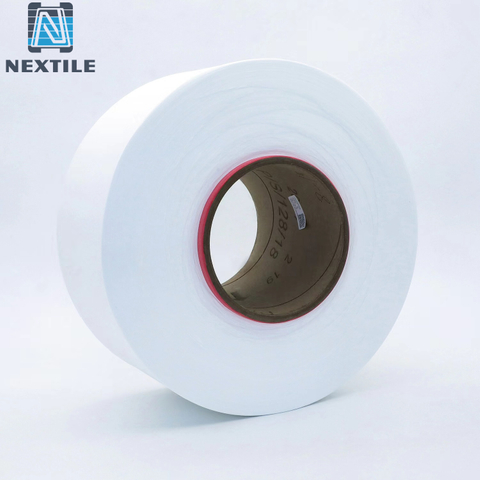
CEY should therefore be treated as a product category rather than one fixed formula. A full-dull 180D/60F yarn and a full-dull 180D/96F yarn may share the CEY name while producing different surface effects, softness, coverage, and fabric behavior. Both specifications are commonly used in composite elastic yarn development.
During yarn preparation, the polyester components are combined under controlled tension. Twisting or compounding helps keep them integrated during weaving, knitting, dyeing, and finishing. Heat or wet processing then encourages differences in shrinkage and mechanical behavior to develop into a three-dimensional crimp.
In bicomponent polyester fibers, attached components with different shrinkage characteristics can form a spiral or coiled structure after thermal treatment. This crimp allows the filament to extend under force and recover when the force is removed. Heat-treatment conditions can also change crimp density, elastic recovery, stress relaxation, and other mechanical properties, so processing parameters are central to final performance.
The term full dull refers to the yarn’s reduced luster rather than its stretch mechanism. A full-dull CEY produces a less shiny surface that may appear softer and more refined in fashion fabrics. Its elasticity still comes primarily from the composite structure and the crimp developed during processing.
The principal benefit of Composite polyester CEY yarn is not maximum extension. It is the balance between moderate stretch, movement, and recovery. This makes it useful in garments that should feel comfortable during sitting, walking, bending, or reaching without fitting as tightly as compression clothing.
A well-developed CEY fabric can recover toward its original dimensions after movement. That recovery may help reduce bagging around knees and elbows, permanent distortion, and the loose appearance that develops when a fabric stretches but does not return effectively. Crimped bicomponent polyester structures can provide useful elasticity and recovery between the lower stretch of conventional textured filaments and the stronger extension associated with elastane systems.
However, yarn construction is only one part of the result. Fabric density, yarn direction, weave or knit structure, finishing tension, and heat-setting conditions all influence measurable stretch. A CEY yarn used mainly in the weft may create directional flexibility, while another construction could produce a different balance of stability and movement.
For that reason, universal stretch percentages should not be assigned to the entire category. Buyers should request data for the selected yarn and confirm performance in the intended fabric rather than assuming that every CEY specification behaves alike.
CEY is often chosen as much for its sensory qualities as for its elasticity. Composite CEY yarns can provide a soft, dry touch, resilient fabric performance, and a refined appearance. Full-dull options reduce obvious synthetic shine and support a more subdued surface.
The slightly dry hand distinguishes CEY fabric from some smooth, slippery polyester constructions. It can provide enough body for trousers and lightweight jackets while still allowing dresses, blouses, and skirts to hang naturally. This combination of structure and movement is especially valuable when a designer wants fluidity without an overly limp fabric.
A higher filament count within the same overall denier may also alter the hand and surface. For example, 180D/96F contains more individual filaments than 180D/60F, which can contribute to finer filament distribution and potentially a smoother or fuller fabric surface. The final difference still depends on twist, density, weaving, and finishing, so a sample should be evaluated rather than judged from the specification alone.
Full-dull CEY can also make darker or muted colors appear less reflective under direct light. That characteristic is useful in tailored womenswear, modest fashion, and transitional-season garments where a polished matte appearance may be preferred over brightness.
As an engineered polyester yarn, CEY can support several practical fabric characteristics:
● Dimensional stability and resistance to permanent deformation
● Wrinkle resistance and relatively simple garment care
● Faster drying than many highly absorbent natural fibers
● Durability during repeated wear and laundering
● Stable appearance when the fabric is processed correctly
CEY fabrics can also be developed for moisture management, crease resistance, and dimensional stability. These properties should be treated as product-specific performance objectives rather than guarantees for every finished textile. Fabric weight, construction, finishing, and garment design remain decisive.
CEY does not automatically make a dense polyester fabric highly breathable. A lightweight or relatively open construction may feel comfortable, while a heavy, compact weave may retain more heat. Similarly, quick drying should not be confused with high moisture absorption; polyester usually holds limited moisture within the fiber, and comfort often depends on how effectively the fabric transports moisture across its surface.
The yarn is also not intended to replace spandex in every application. Where very high extension, compression, or strong multidirectional stretch is essential, a polyester-elastane system may be more appropriate. CEY is better understood as a controlled-stretch option for shape, movement, and fabric character.
SSY and SPH may appear both as individual elastic polyester yarns and as components in a CEY construction. CEY differs because it combines the elastic component with another filament, such as POY, to create a composite yarn with its own balance of stretch, drape, body, and surface texture. POY+SSY, POY+SPH, and POY+SYS are common composite combinations.
Ordinary textured polyester is produced to add crimp, bulk, softness, and some flexibility to otherwise smooth filament yarn. It may work well in casualwear, linings, sports textiles, and home furnishings. Its recovery, however, may be lower or less deliberately engineered than a composite elastic yarn intended for stretch fabrics.
Similar denier numbers do not make CEY, SSY, SPH, and textured polyester interchangeable. Buyers should compare actual extension, recovery after repeated cycling, luster, hand, dyeing behavior, shrinkage, and recommended heat-setting conditions. The same nominal yarn size may perform very differently once converted into fabric.
CEY is usually the more suitable option when the desired fabric needs moderate movement, a less body-hugging fit, dimensional stability, fluid drape, and a dry or full-dull surface. Typical examples include dresses, tailored trousers, blouses, relaxed jackets, skirts, and stretch woven fashion fabrics.
A polyester-spandex system is generally better for leggings, swimwear, compression garments, fitted sportswear, and products that must stretch strongly in multiple directions. Elastane can provide substantially greater extension, but it also introduces specific requirements for tension control, heat exposure, chemical resistance, and long-term recovery.
The choice should be based on the finished garment rather than a general claim that one option is superior.
Yarn Type | Stretch Character | Typical Hand | Best-Fit Uses | Main Consideration |
Polyester CEY yarn | Moderate stretch with resilient recovery | Dry, fluid, often matte | Dresses, trousers, jackets, fashion fabrics | Results vary by component and finishing |
SSY or SPH | Crimp-based polyester elasticity | Smooth and resilient | Stretch woven and knitted fabrics | May not create CEY’s composite hand |
Textured polyester | Low to moderate flexibility | Soft and bulky | Casualwear, linings, home textiles | Recovery may be more limited |
Polyester-spandex | High extension and close fit | Soft and flexible | Leggings, swimwear, compression apparel | Requires careful tension and heat control |
Woven apparel is one of the clearest application areas for polyester CEY yarn. Conventional woven fabrics can restrict movement because the yarns themselves have little extension. Introducing a composite elastic yarn, particularly in the weft direction, can improve comfort while maintaining the stability and clean surface associated with woven construction.
Dresses and skirts benefit from CEY’s drape and recovery because the fabric can move with the wearer without losing its intended silhouette. Suit trousers may gain additional sitting and walking comfort while resisting knee bagging. Blouses, lightweight jackets, relaxed tailoring, and modest-fashion garments can use the same balance of movement and shape retention.
Full-dull CEY is particularly suitable for sophisticated womenswear and spring or autumn collections. It can also be developed for plain weaves, twills, and double-layer linen-style constructions, allowing the yarn to support several fabric aesthetics rather than one narrowly defined end use.
The best results depend on coordinating yarn count with fabric weight and density. A light blouse fabric, structured trouser cloth, and double-layer textile will not require identical CEY specifications or finishing conditions.
Selected knitted fabrics can also use CEY when moderate recovery and a refined polyester hand are more important than compression. Potential applications include fashion tops, casual coordinates, comfortable trousers, lightweight cardigans, and transitional-season garments.
Knitting trials are essential because the yarn must pass through guides and needles consistently while maintaining stable tension. Loop formation, yarn twist, relaxation shrinkage, and heat development can influence width, weight, surface evenness, and recovery. A cone that looks satisfactory in isolation may behave differently on a high-speed knitting machine.
CEY is less suitable when the product requires extreme extension or powerful elastic force. Compression sportswear, high-stretch leggings, heavy elastic bands, and strongly body-contoured garments will usually need an elastane-containing structure or another specialized elastic system.
Application decisions should therefore begin with the target fabric. The yarn label alone cannot determine whether the final textile will deliver the required stretch, appearance, and comfort.
Polyester CEY yarn offers a practical balance of moderate stretch, recovery, dimensional stability, and fluid drape without creating the tight feel associated with high-elastane fabrics. Its suitability still depends on the composite structure, filament count, twist, luster, and finishing conditions, so fabric-level testing remains essential before bulk production.
Nextile Fiber Technology Co. Ltd. supplies CEY composite yarn options for woven and selected knitted applications. Matching the appropriate specification to the intended fabric can improve processing consistency, garment comfort, shape retention, and overall product performance while reducing costly development adjustments.
A: Polyester CEY yarn is a composite elastic filament made from different polyester components. It provides moderate stretch, recovery, drape, and dimensional stability without relying on spandex.
A: CEY commonly combines POY with elastic polyester components such as SSY, SPH, or SYS. The exact construction varies according to the required stretch, hand, and fabric performance.
A: CEY provides controlled mechanical stretch and a less body-hugging feel. Spandex offers greater extension, making it more suitable for compression wear, leggings, and close-fitting sportswear.
A: CEY is commonly used in woven and selected knitted fabrics for dresses, blouses, trousers, skirts, lightweight jackets, casual sets, and other garments requiring comfortable movement.
A: Yes, CEY can be processed through weaving and knitting. However, yarn tension, heat setting, shrinkage, loop formation, and recovery should be tested before bulk production.
A: The first number indicates yarn denier, while the second shows filament count. These values influence fabric weight, coverage, softness, surface texture, and processing behavior.