
 English


Views: 0 Author: Site Editor Publish Time: 2026-07-10 Origin: Site


A yarn label such as 75D/36F can look simple until you need to compare two materials or predict how they may behave in fabric. So, what does 75D/36F mean? It identifies a filament yarn with a total linear density of 75 denier made from 36 individual filaments. Dividing 75 by 36 gives about 2.08 DPF, or denier per filament. Knowing how denier, filament count, and DPF relate helps you compare yarn fineness more accurately, understand likely differences in fabric hand and surface character, and read supplier specifications with fewer assumptions.
Denier is a direct measure of linear density. In the denier system, the number represents the weight in grams of 9,000 meters of yarn or fiber, so 9,000 meters of a 75D yarn weighs 75 grams. This is more precise than describing yarn simply as “thin” or “thick,” because physical diameter can also vary with construction, texturing, and other characteristics.
A common mistake is to read 75D as though every filament inside the yarn were 75 denier. It is not. The 75 denier applies to the complete multifilament bundle. Under otherwise comparable conditions, increasing total denier generally means more mass per unit length and a heavier or coarser yarn, while decreasing it produces a lighter and finer yarn.
The F in 75D/36F refers to filament count. A 36F yarn contains 36 continuous filament strands bundled together, and all 36 collectively make up the total 75D linear density. In practical terms, D tells you the size of the whole bundle, while F describes how that bundle is internally divided.
That distinction is why a sourcing request for only “75D polyester yarn” may be incomplete. A 75D yarn made from 36 filaments and one made from 72 filaments have the same total linear density, but their individual filaments are not equally fine. Their finished fabrics can therefore develop different tactile and surface characteristics even before factors such as texturing, luster, or fabric construction are considered.
The slash can also cause confusion for buyers familiar with spun-yarn counts. In a filament notation such as 75D/36F, the second number is a filament count, not a ply count. Reading it as “75 denier, 36 filaments” prevents that mistake.
DPF means denier per filament, and the calculation is simple:
DPF = Total Denier ÷ Filament Count
For 75D/36F:
75 ÷ 36 = 2.08 DPF
This means each filament has an average linear density of approximately 2.08 denier. If total yarn denier is distributed among a known number of filaments, dividing the total by the filament count gives the average denier of each strand.
DPF is valuable because total denier alone cannot reveal individual filament fineness. Two yarns can both be 75D, yet one can consist of relatively coarse filaments while another contains many finer ones. For fabric development, that difference is often more informative than simply knowing that both yarns share the same 75D designation.
Holding total denier constant makes the effect of filament count easy to see:
Specification | Filaments | DPF | Main difference |
75D/36F | 36 | 2.08 | Relatively coarser individual filaments |
75D/48F | 48 | 1.56 | Finer individual filaments |
75D/72F | 72 | 1.04 | Much finer filament structure |
The pattern is consistent: when total denier stays at 75D, increasing the number of filaments lowers DPF. The yarn does not become heavier merely because more filaments are present; the same total linear density is simply distributed among a larger number of finer strands.
Nextile offers T8 yarn in both 75D/36F and 75D/48F configurations. The comparison illustrates why buyers should read the number after the slash instead of stopping at 75D. Both specifications have the same total denier, but 75D/48F divides that linear density among more filaments and therefore has a lower DPF.
Not normally under the commonly used textile definition. Microfiber is generally associated with individual fibers below about 1 denier, although terminology can vary slightly depending on the standard or application.
At approximately 2.08 DPF, a conventional 75D/36F yarn sits above that range. Filament count alone is therefore not enough to classify a yarn as microfiber; total denier and filament number must be considered together. For comparison, 75D/72F is about 1.04 DPF, while an even higher filament count would be needed to bring a 75D yarn clearly below 1 DPF.

When total denier remains at 75D, choosing 36F instead of a higher filament count means allocating the same mass among fewer, relatively coarser filaments. Those individual filaments generally have greater bending resistance than finer filaments, which can move the resulting fabric toward a firmer, more substantial hand. A higher-F construction divides the same 75D among finer strands that can flex more readily, supporting a softer and more fluid fabric character.
This does not mean 75D/36F automatically produces a stiff fabric. Yarn texturing, knit or weave construction, finishing, and density can substantially modify the result. The useful comparison is relative: if two otherwise similar 75D yarns differ mainly in filament count, the lower-DPF option generally provides the finer filament structure.
Filament fineness also affects the way a yarn bundle builds a fabric surface. Numerous finer filaments create a different contact area and surface geometry from a smaller number of coarser ones. As a result, fabrics made at the same total denier can differ in smoothness, coverage, light reflection, and overall hand.
For sourcing purposes, this explains why “75D polyester” is not enough to predict exactly how a finished fabric will look or feel. A 75D/36F construction may provide a noticeably different surface character from 75D/48F or 75D/72F, even though all three have the same total denier.
DPF should be treated as a filament-fineness indicator, not a complete fabric-performance rating. The notation 75D/36F does not tell you whether the yarn has been textured, what luster level it carries, how the filaments are intermingled, what polymer construction is used, or how the fabric will eventually be knitted, woven, dyed, and finished.
Those variables can materially affect GSM, stretch, strength, drape, pilling behavior, opacity, and moisture management. Claiming an exact finished-fabric property from D/F alone would therefore go beyond what the specification can support. DPF is most useful when comparing the internal fineness of yarns before those additional construction variables are assessed.
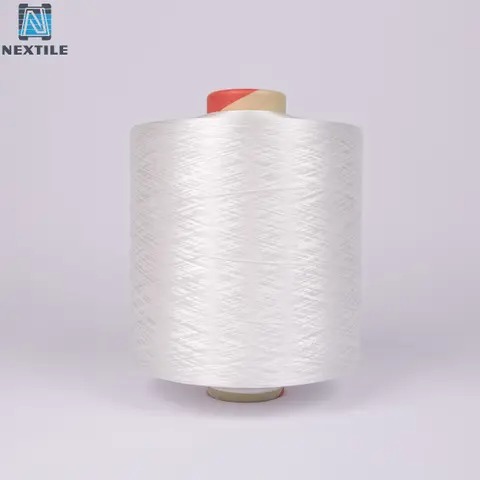
Once 75D, 36F, and DPF have been decoded, the remaining specification still matters. DTY identifies drawn textured yarn, while FDY refers to fully drawn yarn; these constructions differ in processing and in the physical characteristics they can provide. Codes such as SD or FD may indicate luster, SIM refers to an intermingling specification, and RW or dyed descriptions indicate the yarn's color state.
These codes should not be treated as extensions of DPF. They describe separate dimensions of the yarn specification. Two products can therefore share exactly the same 75D/36F notation while differing in texture, elasticity, luster, polymer design, color route, and intended application.
Within Nextile's range, one 75D/36F option uses GRS-certified recycled polyester DTY with dope-dyed black coloration and post-consumer recycled material. Its 75D/36F designation still describes only the yarn's total linear density and filament count; recycled content, texturing, and coloration are separate specification dimensions.
Another 75D/36F construction uses high-performance T8 elastic yarn with a PET/PBT bicomponent structure designed to develop three-dimensional crimp. Differences between the two polymer components can create a three-dimensional crimp that contributes to elasticity. The yarn can therefore share the same 75D/36F numbers with another polyester yarn while having a substantially different material architecture, stretch mechanism, and intended performance.
A reliable reading sequence starts with measurable size and then moves toward construction. First identify D to understand total linear density, then F to establish how many filaments share that denier. Divide the two to obtain DPF, which gives the average fineness of each filament.
After that, check whether the yarn is DTY, FDY, bicomponent, recycled, or another construction. Finally, read the luster, intermingling, color or dye state, and any application-specific requirements. This layered approach prevents a common sourcing error: assuming that matching the first two numbers means the complete yarn specification matches as well.
A useful yarn comparison begins with the intended fabric rather than with the assumption that either a higher or lower filament count is inherently superior. Once the required total denier has been established, filament count and DPF can be used to compare individual-filament fineness and the likely direction of hand and surface differences. Yarn construction and the intended processing route should then be checked before a material is approved.
For a practical sourcing review:
1. Confirm the required total denier for the fabric construction.
2. Compare F count and DPF where filament fineness matters.
3. Check the yarn type and polymer or material construction.
4. Confirm luster, intermingling, color or dye state, and other required codes.
5. Validate the yarn in the intended knitted or woven construction when finished-fabric behavior is critical.
The first mistake is assuming that each filament in 75D/36F is 75 denier. In reality, the 36-filament bundle totals 75D, giving an average of about 2.08 DPF. The second is assuming that 75D/48F must be heavier than 75D/36F because it contains more filaments; both remain 75D, but the 48F construction divides that linear density among finer strands.
The third mistake is treating lower DPF as a universal quality ranking. A lower value tells you that the individual filaments are finer, but finer is not automatically better for every fabric. The correct choice depends on the required hand, structure, processing behavior, and final application rather than on chasing the highest possible filament count.
Understanding what does 75D/36F mean comes down to reading the specification in layers: 75D describes total yarn linear density, 36F gives the filament count, and 2.08 DPF shows the average fineness of each filament. Together, these values make yarn comparisons more accurate and help buyers avoid judging materials by denier alone.
For practical sourcing, Shanghai Nextile Fiber Technology Co. Ltd. offers 75D/36F options across recycled polyester DTY and T8 elastic yarn categories, giving fabric developers different constructions to match specific requirements for texture, stretch, processing, and end use.
A: 75D/36F means the yarn has a total linear density of 75 denier and contains 36 continuous filaments. Each filament averages about 2.08 denier.
A: Divide the total denier by the filament count. For 75D/36F, 75 divided by 36 equals approximately 2.08 DPF, indicating the fineness of each filament.
A: Generally, no. At about 2.08 DPF, 75D/36F is above the commonly used microfiber range of roughly 1 denier per filament or less.
A: Both have the same total denier, but 75D/72F contains twice as many filaments. Its lower DPF generally produces a finer, softer filament structure.
A: No. If total denier remains 75D, increasing filament count does not increase yarn linear density. Instead, the same total mass is divided among more, finer filaments.
A: No. Lower DPF means finer individual filaments, not automatically higher quality. The suitable DPF depends on the required fabric hand, structure, processing, and end use.


